
Categories
buyer, Retirees, sellerPublished June 26, 2026
Bryan vs. College Station: The Complete BCS Area Comparison

Bryan vs. College Station: The Complete BCS Area Comparison
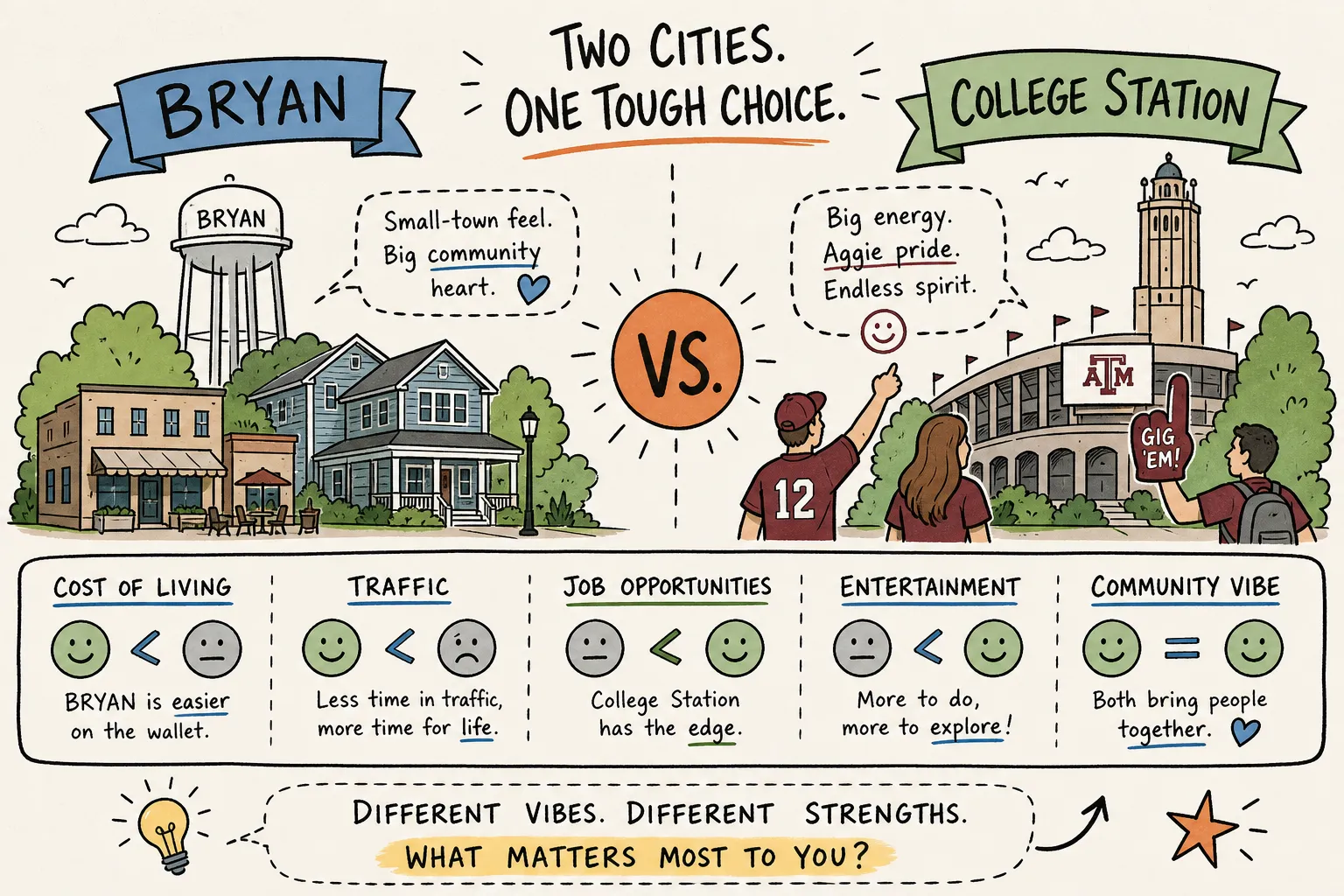
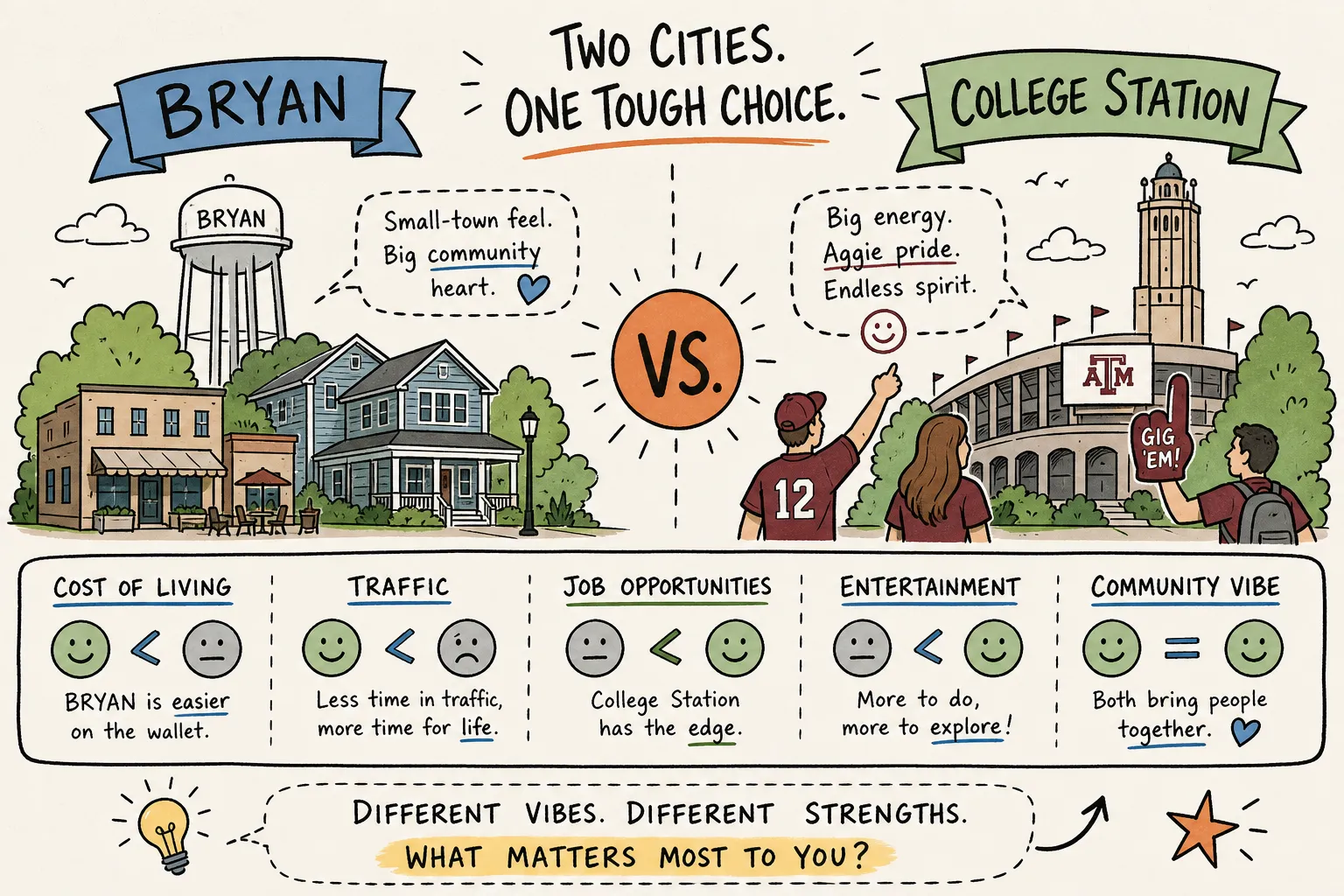 The question comes up every single time. You've accepted a position at Texas A&M, received military orders, or simply decided Brazos Valley is where you're planting roots, and before you even open a home search, someone asks: "Are you thinking Bryan or College Station?" It sounds simple, but it touches every part of your daily life, from your mortgage payment to where your kids go to school. This BCS area comparison breaks down the full side-by-side picture so you can make a confident decision instead of guessing. The BCS metro is home to roughly 287,000 people spread across two distinct cities that share geography, a zip code overlap, and a university, but differ significantly on price, culture, school performance, and neighborhood feel.
Debi Stoll at DoorStep Home Group has been walking buyers through this exact comparison for years. The insight here comes from that same grounded, practical perspective: not which city sounds better, but which one actually fits your household's priorities when the numbers are on the table.
BCS area comparison, Cost of living: what the numbers show
The everyday costs that add up fast
College Station's cost-of-living index sits at 106.2 for housing, which puts it above the U.S. average of 100 but meaningfully below comparable Texas metros. Groceries come in at 90, utilities at 96, and healthcare at 107. Bryan skews slightly more affordable across most categories, with groceries at 90.2 and healthcare at 94.7. This BCS cost of living comparison makes one thing clear: College Station costs a bit more than Bryan in most categories, but both cities offer genuine relief compared to the major Texas metros you may be leaving behind. Groceries and transportation are particularly kind to your budget regardless of which side of town you choose.
The other thing worth noting is that the difference between Bryan and College Station on cost of living is smaller than most newcomers expect. The bigger variable is which specific neighborhood and school zone you're targeting, not just which city label is on your address. Location within either city shapes your actual monthly costs more than the city name alone.
What income levels and household demographics look like
Bryan's median age hovers around 32, anchored by a broad mix of working-class families, long-term residents, and growing professional households. College Station skews younger, driven heavily by Texas A&M's student population, and that demographic reality shapes everything from restaurant options to rental market dynamics. Bryan has approximately 91,996 residents as of July 1, 2025 Census estimates, while the full BCS metro reaches 287,476. For more detailed population breakdowns, consult the local Bryan demographics that outline age, household, and growth patterns. Understanding that the two cities have distinct population profiles helps explain why they feel so different on a Saturday afternoon, even when they share the same stretch of Texas Avenue.
BCS housing market: what your budget gets in each city
Median prices and what they mean for buyers
Bryan's typical home value sits around $268,000 to $275,000, up roughly 1% to 1.2% year-over-year per Zillow's Bryan home values March 2026 figures. College Station's typical home value comes in around $343,000, essentially flat at +0.4% year-over-year. At the neighborhood level within College Station, values range widely: South Knoll averages around $250,200, Central College Station around $264,430, while Tiffany Park reaches $428,052 and Southside lands around $412,448. Average rent in College Station runs approximately $1,755 per month, up 3.8% annually.
What this means for buyers is straightforward: the same monthly mortgage payment that gets you a three-bedroom starter home in College Station often gets you a larger home with more square footage and a bigger yard in Bryan. Families who need space more than they need a particular zip code consistently find more value on the Bryan side of the line. If you want to see a current Bryan listing that reflects the value tradeoff between space and price, check out 706 Edgemore Dr, Bryan, TX 77802 as an example.
Renting vs. buying across both cities
College Station's rental market is directly tied to Texas A&M's enrollment calendar. Lease competition heats up in the spring as students lock down housing for the following academic year, creating seasonal spikes that affect both pricing and availability. Bryan's rental stock is steadier and generally more affordable, though properties tend to be farther from the university's walkable amenities. For buyers who've been renting in College Station and feel the squeeze each lease renewal, the Bryan market often offers a clearer path to homeownership at a lower entry price point, with stronger inventory options at accessible price ranges compared to the investor-heavy corridors near campus. First-time buyers should also consult a local first-time homebuyers' guide to navigate timing, financing, and inspection expectations in this market.
School districts: a deciding factor for families
How Bryan ISD and College Station ISD compare
College Station ISD holds a B rating from the Texas Education Agency, with College Station High School ranked #70 among Texas public high schools and earning an A+ grade from Niche's College Station school rankings. Bryan ISD's student achievement score comes in at 73 out of 100 and its closing-the-gaps score at 71 out of 100. The aggregate gap is real, but it doesn't tell the whole story. Bryan Collegiate High School ranks #190 among Texas public high schools with a Niche A grade, a solid outcome, though still a tier below College Station's top campuses by the available TEA and Niche metrics. For families where school performance is a non-negotiable, College Station ISD consistently leads on publicly available data.
That said, both districts have campuses that receive strong ratings, and Bryan ISD has been making measurable progress year over year. The right move is to research specific campuses in the neighborhood you're considering rather than writing off an entire district based on aggregate scores alone.
Why your specific address matters more than city limits
Bryan ISD and College Station ISD are separate districts with their own attendance zone boundaries, and those boundaries don't always follow obvious city lines. One side of a street can fall into a different district than the other. Buyers who assume their address is in College Station ISD because it has a College Station mailing address sometimes discover after closing that their home feeds into a different zone entirely. Verifying school zoning for every specific address before making an offer is one of the most important steps in the home search process, for example, consult the official CSISD attendance zone maps to confirm which schools a College Station address actually feeds into. A knowledgeable local agent catches this early so it never becomes a post-closing surprise.
Neighborhood character: a BCS area comparison
College Station neighborhoods worth knowing
Southside and Tiffany Park attract established families, professors, and professionals drawn by newer builds, tree-lined streets, and proximity to top CSISD campuses. Eastgate sits closer to the university and draws a mix of long-term residents and buyers looking for investment potential. South Knoll and Central College Station come in at lower price points and appeal to first-time buyers or anyone prioritizing walkability to campus events and university amenities. The Wellborn corridor offers a more open, rural feel with newer construction at relatively accessible prices for buyers who want more land without pushing deep into Bryan.
College Station's commercial and social energy is concentrated along the Texas A&M corridor, which means dining, retail, and entertainment options are plentiful and accessible. The tradeoff is that much of this activity caters to a student demographic, so the neighborhood experience can feel different depending on how close you are to campus.
Bryan neighborhoods that often surprise buyers
Bryan's historic downtown district has undergone genuine revitalization over the past several years. Local restaurants, coffee shops, breweries, art galleries, and boutique retail give it a distinct cultural identity that College Station's commercial strips simply don't replicate. North Bryan tends to be quieter and more suburban in character. The northeast quadrant is statistically the safest part of the city, with a victimization rate of roughly 1 in 57 according to available crime mapping data; central Bryan has higher crime density, with rates closer to 1 in 21, so neighborhood-level research matters there more than anywhere else in the BCS area. For more detailed crime and safety mapping, review the local Bryan crime statistics.
Buyers who want a larger home, a real yard, and a community feel without paying College Station prices consistently find what they're looking for in Bryan. The city's identity is less tied to the university cycle, which gives it a more stable, year-round neighborhood character across many of its sub-areas. For insight into demand in specific Bryan communities, see the local perspective in Selling in Traditions, Why This Bryan Community Is in High Demand.
Safety, jobs, and daily life across the BCS area
Crime rates and how to interpret them
Bryan's most recent available data (FBI-derived estimates, 2023) shows roughly 24 total crimes per 1,000 residents, with violent crime at 4.88 per 1,000 and property crime at 18.68 per 1,000. Within Bryan, the northeast is the safest sub-area at about 1 in 57 victimization odds; central Bryan is the highest-risk zone at around 1 in 21. College Station reports lower crime figures across both categories on comparable per-capita measures, with its suburban residential neighborhoods generally outperforming Bryan's older urban core on safety metrics. Note that different data providers use different index methodologies, so comparing figures across sources requires caution, always check that you're reading the same type of measure before drawing direct comparisons.
Both cities require street-level research before you commit to a neighborhood. Broad city statistics can mask significant block-by-block variation, and the safest parts of Bryan outperform some College Station neighborhoods on the same metrics. Using address-specific crime data rather than city averages gives you a much more accurate picture when you're narrowing your search.
Where people work and what the commute looks like
Texas A&M University is the anchor employer for the entire BCS metro, drawing faculty, staff, and service workers from both cities. College Station leans heavily on education, retail, and food service tied to the university cycle. Bryan carries a stronger manufacturing and healthcare employment base, with major employers including Bryan ISD, St. Joseph Regional Health Center, and Sanderson Farms. FUJIFILM Diosynth Biotechnologies and other industrial employers have facilities in north Bryan, making the city an increasingly attractive option for professionals outside the university ecosystem.
Cross-city commutes are genuinely manageable. Bryan to the Texas A&M campus typically runs 10 to 15 minutes in normal traffic, and residents who live in Bryan while working in College Station consistently describe the drive as a non-issue compared to commutes they dealt with in larger metros. Dining, shopping, and recreation amenities cluster along Texas Avenue and the Highway 6 corridor, accessible from either city. The commute penalty for choosing Bryan over College Station, or vice versa, is real but small.
So which BCS city is the right fit for you?
Matching your priorities to the right side of town
Bryan fits buyers who want more home for their money, can work with Bryan ISD or find a specific campus that meets their needs, and appreciate a city with a distinct local identity that isn't entirely shaped by university enrollment cycles. College Station fits buyers who prioritize school district performance, prefer newer residential neighborhoods, or want proximity to the commercial and cultural activity that surrounds Texas A&M. The right answer depends entirely on your household's specific combination of budget, commute, school zoning requirements, and the feel you want in your daily life, and neither city is objectively better than the other for every buyer.
A useful self-check: if your list starts with "I need College Station ISD and I can stretch the budget," you already know which side of town to focus on. If your list starts with "I need four bedrooms under $300,000 and the commute to A&M is under 20 minutes," Bryan opens up significantly more options. Most buyers land somewhere in between, which is exactly where a personalized conversation with someone who knows both cities at the street level becomes valuable.
Getting a personalized neighborhood match
A side-by-side comparison like this one points you in the right direction, but it can't account for your specific budget, your preferred commute route, the school your kids need to attend, or the feeling you get walking through a neighborhood on a Saturday morning. Those details matter as much as the data. Debi Stoll at DoorStep Home Group | Keller Williams Brazos Valley has guided buyers through this Bryan vs. College Station decision across both cities for years, building personalized neighborhood shortlists based on real lifestyle and budget priorities rather than general city labels. A short conversation can replace weeks of guesswork with a targeted shortlist.
The bottom line on this BCS area comparison
College Station offers stronger school district performance, newer suburban neighborhoods, and higher home values, advantages that are well-documented and worth weighing seriously. Bryan delivers more affordability and square footage per dollar, along with a distinct local culture that's increasingly attractive to buyers who've been priced out of the College Station market or want something different from a university-adjacent commercial strip. At the end of this BCS area comparison, it comes down to which tradeoffs matter least to your household.
For anyone still working through the decision between the two cities, the most important next step isn't more research, it's a conversation with someone who's walked these streets, closed deals on both sides of the city line, and can tell you which blocks actually deliver on the data. Connect with Debi Stoll at DoorStep Home Group | Keller Williams Brazos Valley for a no-pressure conversation about which neighborhoods match your priorities before you lock in your search.

Debi Stoll
| DoorStep Home Group | Keller Williams Brazos Valley
or another way