
Categories
buyerPublished June 16, 2026
Is Buying a Home in College Station Better Than Renting?

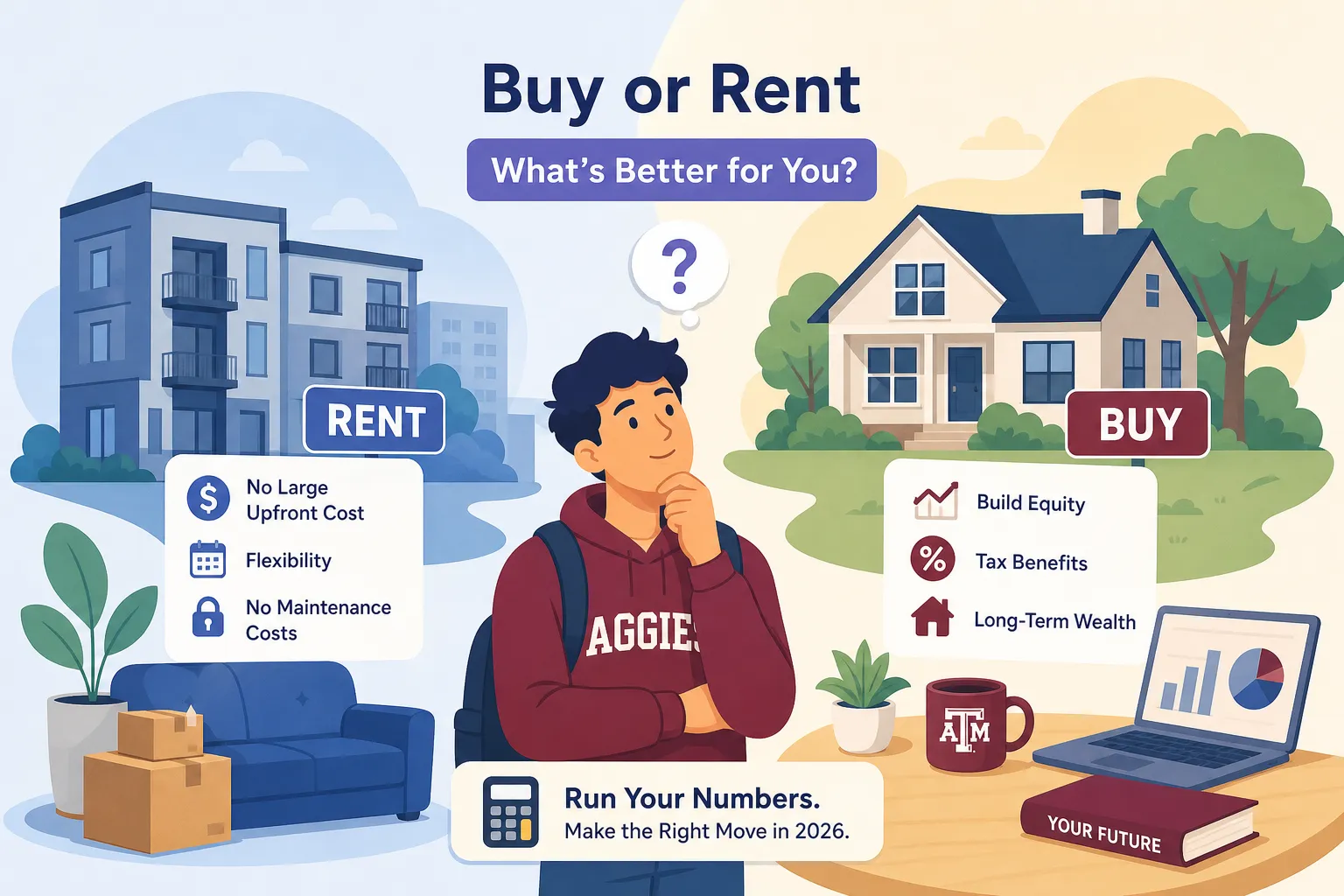
Is Buying a Home in College Station Better Than Renting?
 Rents have climbed in College Station. Home prices have climbed in College Station. And yet the answer to whether you should buy or keep renting is not as obvious as either side of the debate tends to claim. Both paths have real costs, real trade-offs, and a break-even point that depends entirely on your situation.
If you're asking whether buying a home in College Station is better than renting, the honest answer starts with local numbers. Here's where things stand in mid-2026: the median sale price in College Station sits around $331,000, a one-bedroom apartment runs about $1,100 per month, and three-bedroom rentals land between $1,529 and $1,950. Meanwhile, 30-year fixed mortgage rates are averaging in the mid-6% range. Those figures set the stage for a real comparison, not a generic one. Deborah Stoll at DoorStep Home Group, Keller Williams Brazos Valley, runs these numbers with BCS buyers every week, and this article walks through the same framework she uses: buying to live in, buying to rent to Aggie students, and staying a renter for now.
Is buying a home in College Station better than renting? What each option costs per month
Breaking down the true monthly cost of buying in 2026
Start with a realistic purchase scenario: a $331,000 home with 5% down, financed at 6.46% on a 30-year fixed loan. The loan amount is $314,450, and the principal-and-interest payment comes out to roughly $1,985, $2,000 per month. That number alone misleads people, because it leaves out the costs renters never see on their lease.
Layer in property taxes at College Station's combined rate of 1.9065%, homeowners insurance averaging $2,900, $3,700 per year on a mid-range home, and HOA fees where they apply. In neighborhoods with homeowner associations this can add meaningfully to carrying costs, for example, homes such as 6313 Eldora Dr, College Station, TX 77845 illustrate the kinds of communities where HOA dues are a regular line item. When you add those carrying costs to the base payment, the all-in monthly cost of owning a median-priced College Station home lands between $2,700 and $3,100, depending on loan structure and neighborhood. That's the honest number to work from.
What a comparable rental actually costs in the same market
A three-bedroom College Station rental runs $1,529, $1,950 per month in 2026. A four-bedroom near campus ranges from $2,179 to $2,800. Both figures are citywide; properties closer to Texas A&M trend toward the top of each range. On a pure monthly basis, renting a comparable unit in year one typically costs less than owning one. See local College Station rent-market trends for current rental market context.
Renters also carry costs that don't show up in the headline rent figure: renter's insurance, utility deposits on each new lease, and the annual rent increases that compound over a multi-year stay. None of that builds equity. The monthly savings of renting are real in the short term, but they don't stack up the way ownership does over time.
The monthly gap and what it actually buys you
The difference between renting and owning on a median College Station home often runs $400, $800 per month, depending on the specific unit and neighborhood. That gap looks like a cost, but it isn't entirely one. A meaningful portion of every mortgage payment goes to principal paydown, money that comes back to you when you sell. The rest covers the actual cost of using the home. Understanding that split is the lens this analysis uses throughout.
How equity and appreciation change the long-term math in BCS
Principal paydown as a forced savings account
Every mortgage payment reduces your loan balance. Renting delivers zero of that benefit. On a $314,450 loan at 6.46%, the first monthly payment allocates roughly $300 to principal and around $1,693 to interest. Because mortgages are front-loaded with interest, the principal portion grows gradually each year as the loan amortizes. Over a five-year period on a standard 30-year amortization schedule at these terms, a buyer builds roughly $18,000, $20,000 in equity through principal paydown alone, before accounting for any appreciation.
That's money sitting in the home, not spent. When you sell, it comes back. A renter paying $1,700 per month over five years puts $102,000 out the door with no asset to show for it at the end.
Home value appreciation in the College Station market
College Station's housing market is shaped by forces that consistently support demand: Texas A&M's enrollment, steady population growth, and limited housing inventory. The market's long-run annual appreciation rate has historically hovered around 4%, 5% when measured over multi-decade periods, with more recent Redfin data showing a 3% year-over-year gain in 2026's latest snapshot. Even at a conservative 3%, 4% annually, a $331,000 home gains roughly $10,000, $13,000 in value per year.
That appreciation is untaxed until sale, and for a primary residence, the IRS excludes up to $250,000 in capital gains (or $500,000 for married filers) from federal tax. That's a significant shelter renters have no equivalent to. The median listing price per square foot in College Station sits at $199, $201 in 2026, giving you a baseline for modeling future value as the market moves; see current Zillow home values for College Station for up-to-date local valuation trends.
The 4-year calculation that matters for A&M families
Parents buying a home for a student's college years often run a specific version of this math: four years of rent versus four years of equity accumulation plus potential resale. At $1,700 per month in rent over four years, a family pays $81,600 and receives nothing back. A purchased home in the same period builds principal and may appreciate, and can be sold or converted to a rental when the student graduates.
The key caveat is break-even timing. Buying and selling a home in Texas costs roughly 7%, 10% of the home's value in combined transaction costs: agent commissions, closing costs, and pre-sale prep. On a $331,000 home, that's $23,000, $33,000 in friction. Buyers generally need to stay three to five years in the BCS market for ownership to beat renting financially. Four years typically clears that threshold, especially with a disciplined purchase price.
Tax advantages that quietly lower your true cost of ownership
The mortgage interest deduction explained simply
Homeowners who itemize deductions can write off the mortgage interest they pay each year, and that deduction is front-loaded: in the early years of a loan, most of each payment is interest. On a $314,450 loan at 6.46%, year-one interest paid is approximately $20,000. For a household in the 22%, 24% federal tax bracket, that translates to roughly $4,400, $4,800 in actual tax savings. See the details in IRS Publication 936 on mortgage interest deduction rules.
Not every buyer will itemize. The 2026 standard deduction is $15,750 for single filers and $31,500 for married filers, confirm the latest figures with your tax advisor, as the IRS adjusts these annually for inflation. Your total itemized deductions need to exceed those thresholds to benefit. For many BCS buyers, especially those with higher incomes or larger loan balances, itemizing pencils out. Worth running the numbers with a tax professional before closing.
Texas homestead exemption and what it means for your tax bill
Texas has no state income tax, which is a real advantage for homeowners. Property taxes, however, are significant at the combined 1.9% rate. The Texas homestead exemption for 2026 reduces your school district taxable value by $140,000 if the home is your primary residence. On a $331,000 home, that means the school district taxes you as if the home is worth $191,000 instead.
Using the Brazos County school district tax rate of approximately 0.55%, that reduction generates roughly $770 in annual school tax savings, your actual savings will vary based on your specific district rate, so confirm with the local appraisal district. For background on how homestead exemptions work in Texas, see this Texas A&M Real Estate Center overview of homestead exemptions. Combined with the mortgage interest deduction, these tax advantages can shave $200, $400 off the effective monthly cost of ownership when spread across the year, meaningfully closing the gap between owning and renting for primary-residence buyers.
The student rental investment angle: buying near Texas A&M
What gross rental yields look like in College Station
Investors looking at College Station student housing can reasonably expect gross rental yields of 6%, 9% citywide, with well-positioned single-family homes near campus potentially reaching 8%, 12% depending on configuration and location. A $331,000 home renting for $2,400 per month, a realistic four-bedroom near-campus rate, produces a gross yield of about 8.7%, above the national average for residential rentals. That's an attractive headline number, but gross yield is not net yield. For real-life examples of near-campus rental options, consider listings such as 405 Ayrshire St, College Station, TX 77840.
Subtract property taxes, insurance, routine maintenance at 1%, 2% of home value annually, and vacancy loss, and the actual cash-on-cash return tightens considerably. Investors who go in expecting 8% and don't model expenses often find the real return lands closer to 4%, 5%. That can still outperform many alternatives, but the math needs to be done honestly before committing.
Occupancy patterns and the A&M rental calendar
Student housing near Texas A&M typically operates at 90%, 98% occupancy during the academic year, with pre-leasing activity starting months before move-in. The concentrated summer turnover is the primary vacancy risk: properties that don't re-lease before May face a longer gap window. Annual tenant turnover is higher than with family rentals, which means more wear, more cleaning, and more management time between leases. Townhome options and smaller properties also circulate frequently, see a nearby example at 1450 Ailin Dr, College Station, TX 77845.
The four-unrelated-occupants rule and investment strategy
College Station zoning limits single-family homes to no more than four unrelated occupants. That cap shapes the investment math directly. A four-bedroom home renting at $700 per person generates $2,800 per month; adding a fifth bedroom doesn't legally expand that income in most cases. Investors who understand this constraint typically target three- to four-bedroom homes priced at or below $350,000, positioned within reach of campus, and plan the return around four occupants rather than hoping to pack in more.
When renting still makes more sense in College Station
Short stays, high transaction costs, and break-even math
If your timeline in College Station is under three years, renting is the financially smarter move. Buying and selling a home costs 7%, 10% of the home's value in combined transaction costs: agent commissions, closing costs, and pre-sale prep. On a $331,000 home, that's $23,000, $33,000 in friction. Appreciation and principal paydown in a two-year window rarely cover that gap.
Faculty on visiting appointments, corporate transferees on short assignments, and graduate students finishing a dissertation are clear examples where renting protects liquidity. There's no shame in that math. If your time in BCS is short, renting is the right call, staying flexible costs far less than selling too soon.
Down payment readiness and cash reserves
A 5% down payment on a $331,000 home is $16,550, but that's just the entry point. Closing costs add another 2%, 3% of the purchase price (roughly $6,600, $9,900), and a smart buyer also keeps a maintenance reserve accessible after closing. Add those together and the realistic cash requirement before you're truly ready to buy falls in the range of $25,000, $30,000. Buyers who close at the limit of their savings often face real financial stress when the first HVAC unit fails or a roof repair comes up in year two.
Renting while building reserves is not a setback. It's disciplined preparation. Buyers who arrive at closing with a cushion are in a far stronger position than those who got there six months sooner with nothing left in the bank.
Running your own rent-vs-buy calculation for College Station
The key inputs that change everything in your scenario
Every rent-vs-buy analysis comes down to four variables: purchase price, down payment, how long you plan to stay, and what you'd otherwise pay in rent. A buyer putting 10% down on a $310,000 home with an FHA rate of 5.38% has a very different monthly picture than a buyer using conventional financing at 6.46% with 3% down. The math is personal, and the inputs matter more than any general rule.
A rigorous local calculation also factors in loan type, interest rate, expected years in the home, estimated appreciation, and your federal tax bracket. Plugging in realistic local numbers, rather than national averages, is what makes the analysis useful for a BCS decision. Consider using an online amortization calculator alongside current BCS market data to stress-test your scenario before you commit.
First-time buyer programs available in Texas in 2026
The Texas Department of Housing and Community Affairs offers the My First Texas Home program, which pairs a 30-year below-market mortgage with down payment and closing-cost assistance of up to 5% of the loan amount. On a $150,000 loan, that's $7,500; on a $320,000 loan, that's $16,000, illustrating how the program scales with your financing. The assistance is structured as a 0% interest second lien, and a 3-year forgivable option may be available depending on eligibility. Buyers need a minimum 620 credit score and must stay within TDHCA income limits for their county and household size.
These programs can shift the buying-vs-renting calculation meaningfully. A buyer who qualifies for assistance in that $7,500, $16,000 range has a lower cash-out-of-pocket requirement and reaches the break-even point faster. Additional lender-specific products exist for buyers in the BCS market, particularly those with moderate income or limited savings. The options are worth exploring before assuming you need to wait.
How DoorStep Home Group helps you model your specific numbers
Deborah Stoll and the DoorStep Home Group team at Keller Williams Brazos Valley work with buyers at exactly this stage: before a decision is made, when the numbers still need to be tested against real market data. Debi can connect buyers with local lenders who offer first-time buyer programs, walk through what a realistic all-in monthly payment looks like at current BCS prices, and run scenarios comparing buying now versus waiting 12, 18 months.
For buyers who aren't ready yet, that conversation is just as valuable. Knowing your number and your timeline gives you a clear, actionable path forward instead of a vague sense of uncertainty about one of the biggest financial decisions you'll make.
So, is buying a home in College Station better than renting?
For buyers planning to stay three or more years who have their down payment and reserves in order, the answer leans strongly toward yes. The equity accumulation, tax advantages, and College Station's steady appreciation trends make ownership the stronger financial move over time. The monthly cost of owning is higher in year one, but the wealth-building gap widens in the owner's favor every year after that.
For shorter stays or buyers still building savings, renting remains the smarter play. The transaction costs of buying and selling are too significant to overcome in under three years, and stretching to close without a financial cushion creates risk that outweighs any equity benefit. For A&M parents and investors, a well-chosen three- to four-bedroom home near campus can deliver reliable rental yield and meaningful appreciation when purchased at the right price point.
Ready to run the numbers for your specific situation? Connect with Deborah Stoll at DoorStep Home Group, Keller Williams Brazos Valley. Whether you're weighing the rent-vs-buy decision, exploring first-time buyer programs in Texas, or evaluating a student rental investment near campus, Debi brings deep BCS market knowledge and a genuine interest in helping you land in the right place. Reach out to start the conversation.

Debi Stoll
| DoorStep Home Group | Keller Williams Brazos Valley
or another way